· XingAI Platform
MCP Architecture: Connection Patterns and Auth That Hold Up in Production
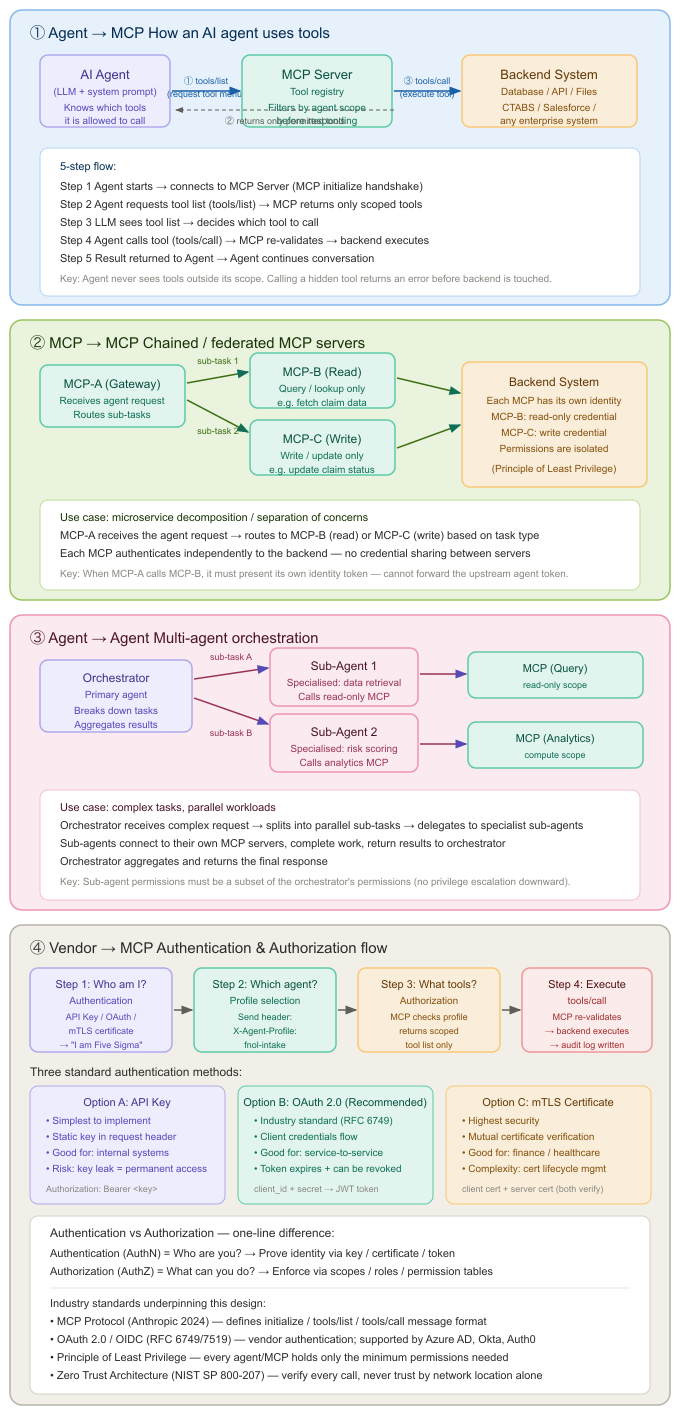
Model Context Protocol (MCP) gives agents a standard way to discover and call tools. That part is easy to demo. Production is harder: scoped permissions, chained servers, multi-agent workflows, and auth that does not collapse the moment someone adds a second integration.
This post walks through four patterns we use when wiring agents to enterprise backends — and the auth model that keeps them from turning into "one API key to rule them all."
Why this matters now
Most teams start with a single agent and a handful of tools. It works until:
- A second product team wants the same CRM connector with different permissions.
- A "read claims" agent accidentally gets write tools because they share one MCP server.
- A gateway forwards the user's token downstream and bypasses your audit trail.
MCP does not solve those problems by itself. You still need explicit architecture: who connects to whom, which credentials travel where, and where authorization is enforced.
The diagram above maps four layers. Each layer answers a different scaling question.
Pattern 1: Agent → MCP (the baseline)
Question: How does an AI agent safely use tools?
This is the default MCP flow:
- Initialize — Agent connects to the MCP server (
initializehandshake). - Discover — Agent calls
tools/list. The server returns only tools in that agent's scope. - Decide — The LLM picks a tool from the visible list.
- Execute — Agent calls
tools/call. The server re-validates scope, then hits the backend (database, API, files). - Continue — Result goes back to the agent; the conversation moves on.
The critical rule: the agent never sees out-of-scope tools. If it tries to call a hidden tool anyway, MCP rejects the call before the backend runs.
That double gate — filter on list, validate on call — is not redundant. Listing shapes what the model can think about. Re-validation catches prompt injection, stale sessions, or agents that guess tool names.
What to implement
| Layer | Responsibility |
|---|---|
| Agent | Holds system prompt + allowed profile; never stores backend credentials |
| MCP server | Tool registry, scope filter, audit log on tools/call |
| Backend | Business logic; trusts MCP's service identity, not the end user |
Example backends: internal APIs, Salesforce, claims systems (CTABS), file stores. The pattern is the same regardless of vendor.
Pattern 2: MCP → MCP (chained / federated servers)
Question: One MCP is getting fat. How do you split read and write without sharing keys?
Use a gateway MCP (MCP-A) that routes sub-tasks to specialist servers:
- MCP-B (Read) — query / lookup only, e.g. fetch claim data.
- MCP-C (Write) — update / mutate only, e.g. change claim status.
Each downstream MCP authenticates to the backend with its own credential. MCP-B gets read-only access. MCP-C gets write access. No shared secret between B and C.
The rule people get wrong
When MCP-A calls MCP-B, it must present MCP-A's identity token — not the upstream agent's token.
If you forward the agent token, you lose:
- Independent revocation (kill one MCP without killing the agent).
- Least-privilege boundaries (B and C inherit the agent's full scope).
- Clean audit logs (you cannot tell which server actually acted).
This is microservice decomposition applied to tool servers. Same separation-of-concerns argument as splitting a monolith — just at the MCP layer.
Pattern 3: Agent → Agent (multi-agent orchestration)
Question: One agent cannot do everything well. How do you parallelize without privilege creep?
An orchestrator agent breaks a complex request into sub-tasks and delegates to specialist sub-agents:
- Sub-Agent 1 — data retrieval → read-only MCP.
- Sub-Agent 2 — risk scoring → analytics MCP.
Sub-agents run in parallel when possible. The orchestrator aggregates results and returns one answer to the user.
Downward permission rule
Sub-agent permissions must be a subset of the orchestrator's permissions.
The orchestrator is the trust boundary. If Sub-Agent 2 can call a write tool the orchestrator was never allowed to use, you have privilege escalation by architecture — not by bug, but by design mistake.
In practice:
- Define agent profiles in config (not in prompts).
- Pass profile ID, not raw credentials, to sub-agents.
- Log orchestrator → sub-agent delegation with correlation IDs.
Pattern 4: Vendor → MCP (authentication and authorization)
Question: A vendor (or internal service) connects to your MCP. How do you know who they are and what they can do?
Treat it as four steps:
| Step | Name | What happens |
|---|---|---|
| 1 | Authentication (AuthN) | Prove identity — API key, OAuth token, or mTLS cert. "I am Five Sigma." |
| 2 | Profile selection | Client sends agent profile, e.g. X-Agent-Profile: fnol-intake. |
| 3 | Authorization (AuthZ) | MCP maps profile → allowed tools; tools/list returns scoped menu only. |
| 4 | Execute | tools/call → re-validate → backend → audit log. |
AuthN vs AuthZ in one line:
- AuthN = Who are you?
- AuthZ = What can you do?
Do not skip step 3 because step 1 "already authenticated them." Vendor identity ≠ agent capability.
Three auth options (pick by risk tier)
| Option | Best for | Trade-off |
|---|---|---|
| A. API key | Internal systems, dev/staging | Simple; leak = long-lived access |
| B. OAuth 2.0 client credentials | Service-to-service (recommended default) | Tokens expire; revocable; works with Azure AD, Okta, Auth0 |
| C. mTLS | Finance, healthcare, high-assurance | Strongest; cert lifecycle is operational work |
For most B2B MCP endpoints, OAuth 2.0 client credentials plus scoped agent profiles is the sweet spot.
Standards this design aligns with
- MCP protocol —
initialize,tools/list,tools/callmessage contract. - OAuth 2.0 / OIDC (RFC 6749 / 7519) — vendor and service identity.
- Least privilege — every agent and MCP server gets minimum permissions.
- Zero trust (NIST SP 800-207) — verify every call; network location is not proof of trust.
Decision guide: which pattern when?
| Situation | Start here |
|---|---|
| First MCP integration, one agent, few tools | Pattern 1 only |
| Same backend, different read/write policies | Pattern 2 (split MCP-B / MCP-C) |
| Long-running workflows, parallel research + action | Pattern 3 (orchestrator + sub-agents) |
| External vendor or multi-tenant access | Pattern 4 (full AuthN + AuthZ + audit) |
You can combine them. An orchestrator (Pattern 3) might call a gateway MCP (Pattern 2) that fans out to read/write servers — each step still enforcing scope.
Checklist before production
-
tools/listfiltered by agent profile — not a global export of every tool. -
tools/callre-validates profile before backend execution. - MCP-to-MCP calls use server identity; no upstream token forwarding.
- Sub-agents scoped ≤ orchestrator permissions.
- Audit log: who, which profile, which tool, timestamp, correlation ID.
- Secrets in env / vault — never in repo or agent prompts.
Closing thought
MCP standardizes the wire format. It does not standardize your security model. The teams that ship safely treat MCP servers like microservices: bounded context, own credentials, explicit authorization at the boundary.
Get Pattern 1 right first. Add Pattern 2 when permissions diverge. Reach for Pattern 3 when latency or specialization demands it. Pattern 4 is non-negotiable the moment someone outside your team connects.
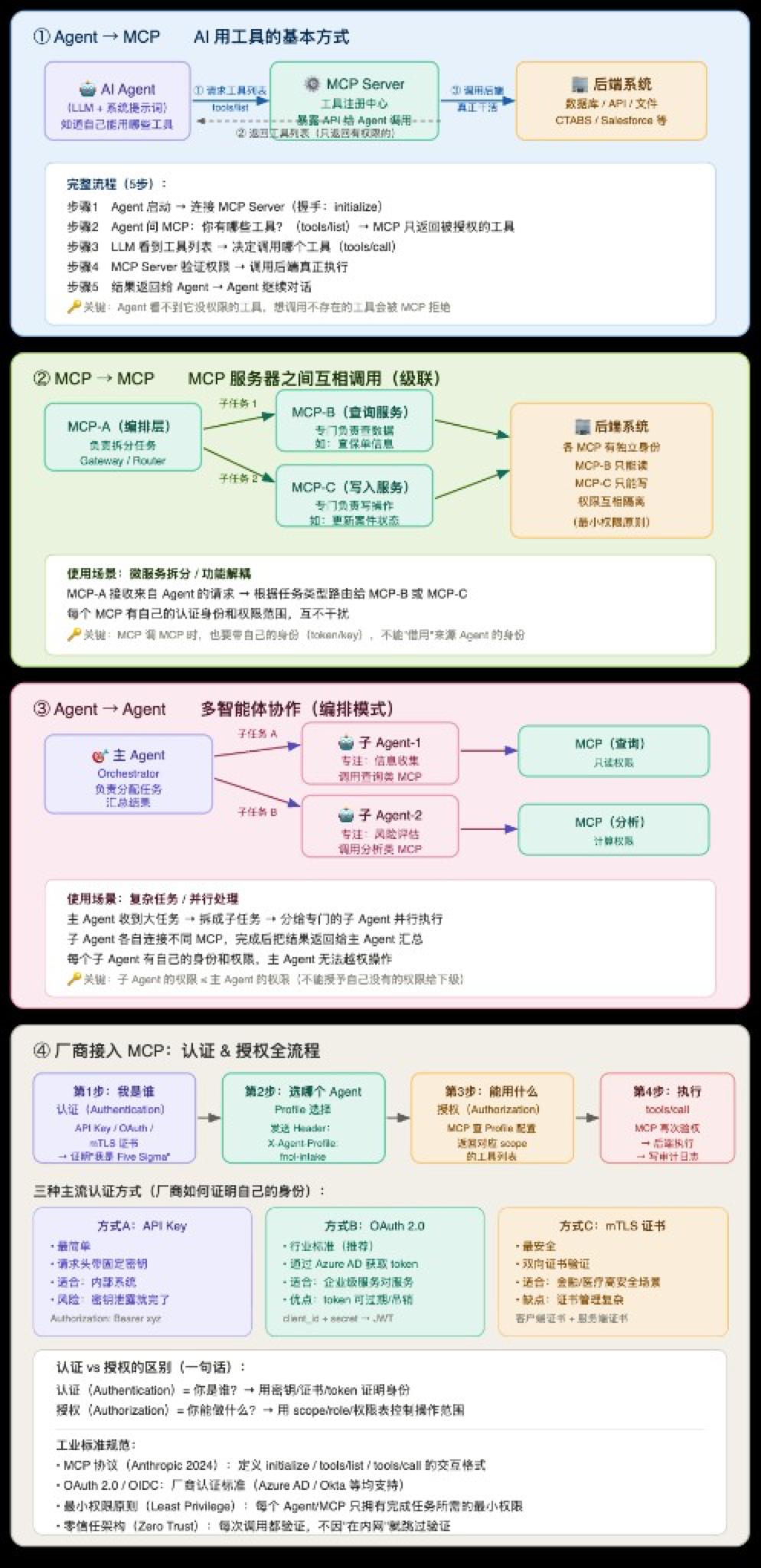
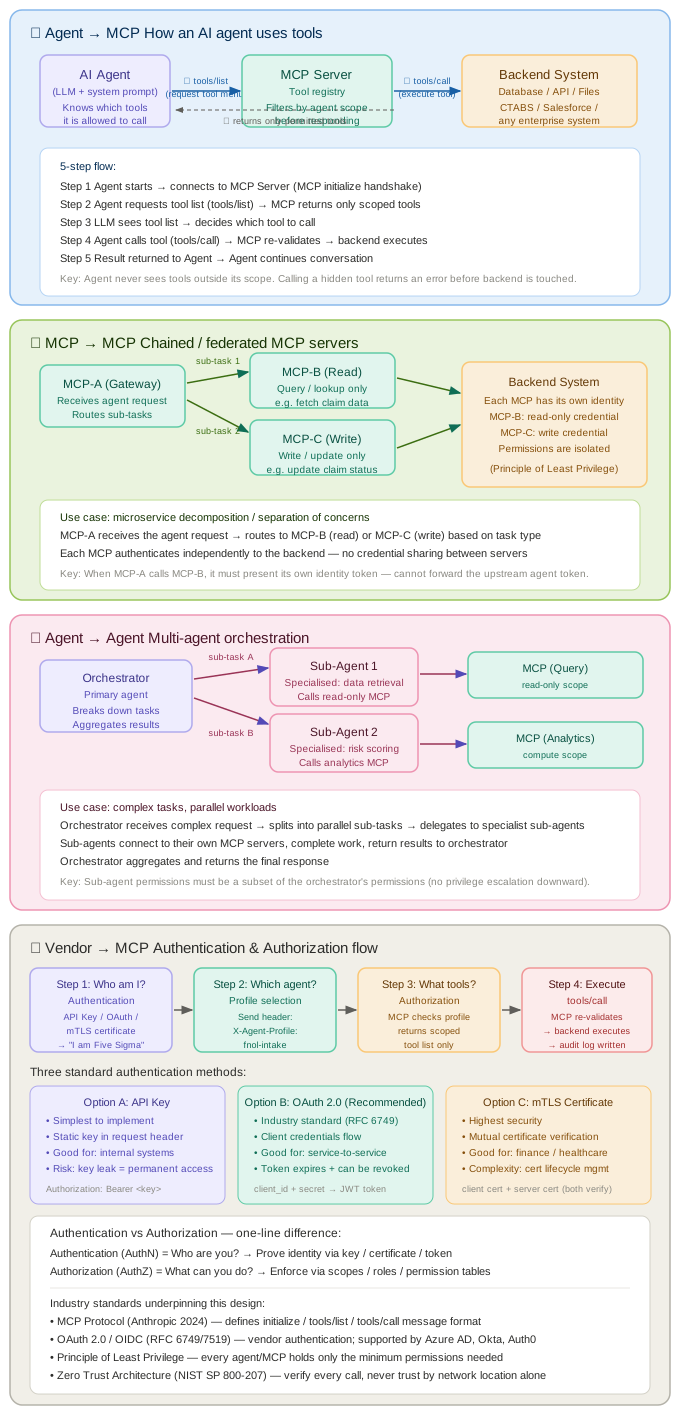
Diagram: English PNG · 中文 PNG · SVG source
Part of the XingAI Tech Blog. We build focused AI decision systems for everyday life.